Description
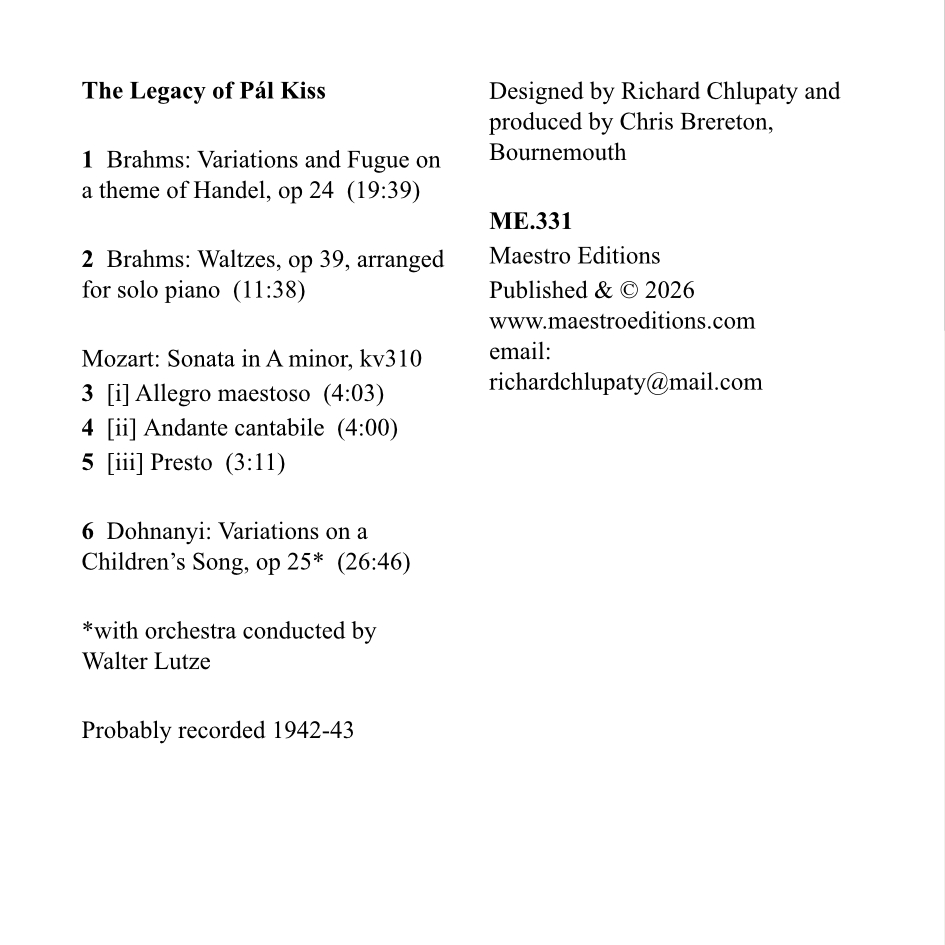
Kiss plays Brahms’s Waltzes as a continuous sequence, but reverses the order of the last two to end with the poignant no 15. He conveys an innate feeling for Viennese style – Brahms in lighter mood – and everything is done with cultivated musical taste, never contrived.
He plays the first movement of Mozart’s A minor Sonata KV310 without repeats, at quite a brisk tempo and very fluently, a splendidly direct approach. The passagework is beautifully shaped, a little abrupt, rather clipped at times but never perfunctory. The Andante reveals an almost improvisatory approach, even an element of skittishness here and there which may come as a surprise to some listeners accustomed to a more conventional interpretation. The final Presto goes along splendidly at an appropriate tempo and beautifully played. Like most pianists Kiss relaxes the tempo for the central section in the major key – and he extricates himself impressively from a slight memory problem near the end.
In the Dohnányi Variations on a Nursery Song one is immediately impressed by the fine balance and integration between soloist and orchestra, giving an almost chamber music quality to the performance. The piano playing itself is on a very high level. The faster variations are not played with quite the astonishing facility evident in the recordings by Julius Katchen and Cyril Smith, yet Kiss’s performance is totally convincing and masterly on its own terms. We can only wonder what he might have achieved, had he not been senselessly murdered.
Nicholas Brown, 2026